
Childhood experiences of threat and deprivation predict distinct depressive symptoms: A parallel latent growth curve model
Published in Journal of Affective Disorders, 2022
Highlights
- Threat and deprivation impact distinct dimensions of depressive symptoms over time.
- Depressed mood was predicted by both threat and deprivation, especially threat.
- Deprivation uniquely conferred to risk of depression via elevated anhedonia.
- The deleterious effects of threat and deprivation would persist during emerging adulthood.
- The prediction of CT on depressive symptoms was stronger in females.
Threat and Deprivation predict distinct depressive symptoms
Abstract
Background/aim There is growing awareness that specific childhood trauma (CT) may confer to the unique risk of depression, but little is known about this. The present study seeks to provide insight into how CT subtypes may impact distinct depressive symptoms over time based on the dimensional model of adversity (DMA).
Methods A total of 3535 college freshmen participated in a 2-year, four waves longitudinal tracking study. A conditional parallel latent growth curve model (LGCM) was constructed to examine the impacts of different types of CT (threat and deprivation) on the development of depressed mood and anhedonia, and whether these relationships vary across gender.
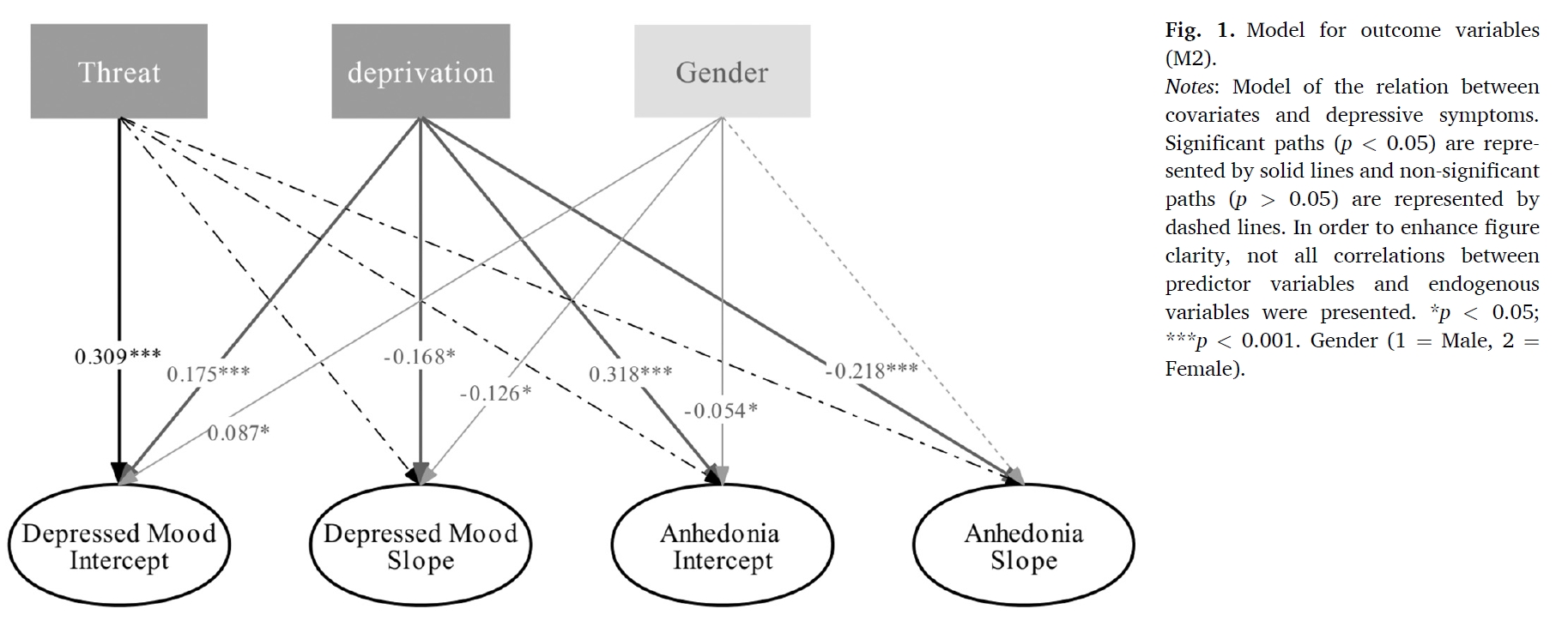
Results Our findings revealed that threat and deprivation could differentially relate to depressed mood and anhedonia. Both threat and deprivation predicted initial depressed mood levels (β = 0.309, p < 0.001; β = 0.175, p < 0.001, respectively) and its trajectory (β = −0.139, p = 0.068; β = −0.168, p < 0.05, respectively). Only deprivation predicted anhedonia levels (β = 0.318, p < 0.001) and trajectory (β = −0.218, p < 0.001). This pattern of relationships between CT and depressive symptoms varied across gender.
Conclusion These findings highlight specific pathways and symptomatic manifestations of the impacts of different CT subtypes on depression and are consistent with the hypothesis of DMA. Threat and deprivation predicted more severe depressed mood, whereas deprivation uniquely conferred to the risk of depression via elevated anhedonia. Meanwhile, the deleterious effects of CT would persist during early adulthood. Gender differences were also discussed.
Recommended citation: Wang, X., Lu, J., Liu, Q., et al. (2022). Childhood experiences of threat and deprivation predict distinct depressive symptoms: A parallel latent growth curve model. Journal of Affective Disorders. 319:244-251.
Download Paper | Read Online